-褪底.png)

High-Capacity Phone Batteries: What B2B Buyers Should Know About Real mAh
High-capacity replacement batteries are becoming increasingly common in the phone repair market.
For the same phone model, buyers may see products described as:
- 100% mAh
- Full Capacity
- High Capacity
- Extended Capacity
But these terms do not all mean the same thing.
For professional buyers, the first question should not simply be:
How many mAh are printed on the label?
A better question is:
How much capacity can the battery actually deliver?
What Does “100% mAh” Mean?
In the replacement battery market, “100% mAh” is commonly used to describe batteries whose actual capacity is intended to closely match the capacity stated on the product specification or label.
However:
“100% mAh” is not an international battery standard.
For B2B buyers, the important point is whether the claimed capacity is supported by actual battery performance.
Useful capacity information may include:
- actual mAh / Ah;
- actual Wh;
- defined test conditions;
- results from multiple samples;
- batch consistency.
The label makes the claim. Actual performance provides the evidence.
“100% mAh” Is Not the Same as High Capacity
These two concepts are different.
“100% mAh”
This focuses on:
Capacity Accuracy
The question is:
Does the battery actually deliver the capacity it claims?
High Capacity
This focuses on:
Capacity Increase
The question is:
Can the battery provide more usable energy than a standard-capacity battery for the same phone?
A larger number printed on the label does not automatically prove either one.
How Can the Same-Size Battery Have More Capacity?
Smartphones have very limited internal space.
Higher capacity may be achieved through different engineering approaches, including:
- higher energy density;
- optimized electrode design;
- better internal space utilization;
- an appropriate usable voltage window.
Different batteries may use different designs.
Any change in the usable voltage window must remain compatible with the cell chemistry and the phone’s charging system.
The key point is:
More capacity should come from real engineering—not simply a larger number on the label.
Does Higher Capacity Always Mean Better?
Not necessarily.
Higher usable capacity can provide longer runtime, which can be a strong advantage for many customers.
But fitting more energy into the same limited space can also place greater demands on:
- cycle performance;
- temperature control;
- thickness and swelling control;
- manufacturing consistency.
So for B2B buyers, a high-capacity battery should not be evaluated by initial mAh alone.
The extra capacity also needs to remain stable in real use.
Can High Capacity Damage the Phone?
Higher mAh does not automatically mean higher voltage.
Capacity and voltage are different specifications.
A properly designed replacement battery still needs to match the target phone in areas such as:
- nominal voltage;
- charge-limit voltage;
- PCM / BMS;
- connector;
- physical dimensions and thickness;
- charging compatibility.
So the real question is not simply:
“Is the capacity higher?”
It is:
“How was the extra capacity achieved, and is the complete battery system properly matched?”
What Should B2B Buyers Check?
For repair shops, wholesalers and distributors, capacity is only one part of the purchasing decision.
A professional buyer should also consider:
- actual capacity / Wh;
- internal resistance;
- cycle performance;
- temperature;
- thickness / swelling;
- compatibility;
- batch consistency;
For B2B buyers, one good sample is not enough.
What matters is:
Repeatable quality across the batch.
Standard Capacity or High Capacity?
There is no single answer for every market.
Standard-capacity batteries may suit buyers looking for a more conservative product option.
High-capacity batteries can provide longer runtime if the extra capacity is real, compatible and supported by stable product design and manufacturing.
For repair channels, the best battery is therefore not always the one with the largest mAh number.
It is the one that balances:
Real Capacity · Runtime · Compatibility · Reliability · Return Risk
VOBOX Capacity Approach
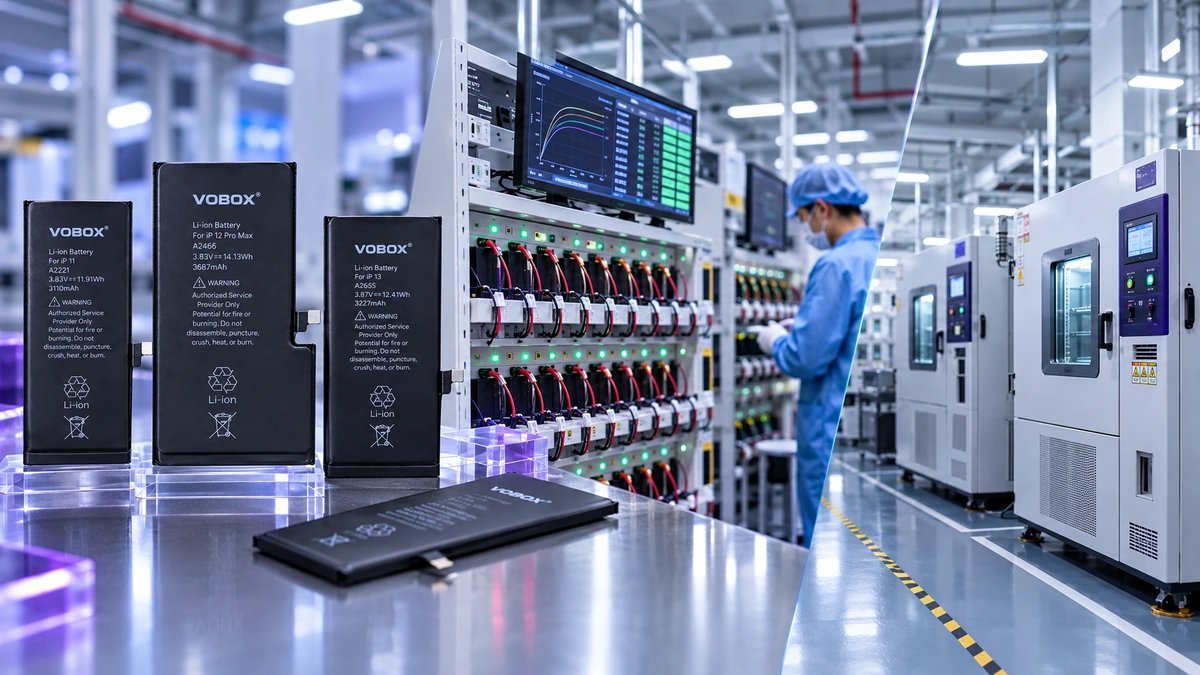
VOBOX uses “100% mAh” to express our focus on capacity accuracy:
The capacity stated for the product should be supported by its actual performance, rather than simply by a larger number printed on the label.
VOBOX provides both standard-capacity and high-capacity phone battery solutions for different market needs.
But capacity is only one part of finished battery quality.
To support stable finished-product performance, VOBOX also focuses on the matching and consistency of multiple stages, including:
- cell specifications
- PCM / BMS configuration
- PACK assembly
- welding and insulation
- electrical compatibility
- production process control
- batch quality consistency
Our goal is not only to provide more mAh.
It is to deliver a complete battery system with:
Real Capacity · Proper Matching · Stable Batch Performance
For detailed product specifications or OEM / ODM requirements, please contact our team.
The Bottom Line
When sourcing phone batteries, do not ask only:
How many mAh?
Also ask:
Is the capacity real?
How was the extra capacity achieved?
Is the battery properly matched to the phone?
Can the same quality be maintained across the batch?
For B2B buyers:
Real mAh matters—but consistent finished-battery quality matters even more.
OEM / ODM Phone Battery Solutions
VOBOX supports standard-capacity and high-capacity replacement battery programs for repair, wholesale, distribution and private-label customers.
OEM / ODM · Custom Packaging · Bulk Supply